

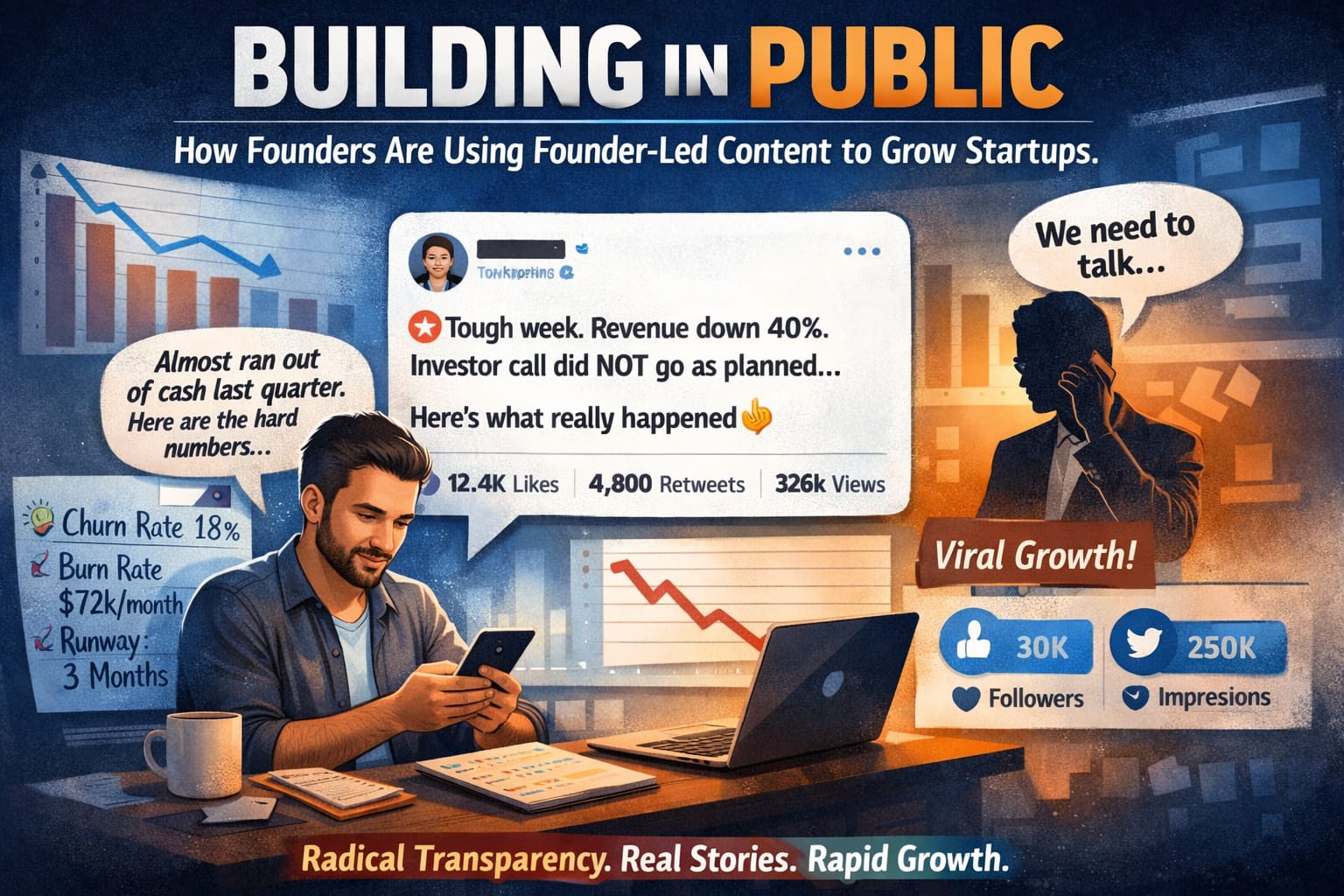
Hypothetically, there is a founder somewhere right now posting an X (formerly Twitter) thread about how their startup nearly died last quarter. They are sharing the exact numbers, churn rate, burn rate, and the conversation with their lead investor that almost did not go well. There is no PR filter or communications team, other than themselves, their phone, and radical honesty about what building a company actually feels like.
And their audience is growing faster than their competitor’s ad budget ever could. This is a strategy and may be the most important growth lever a founder has.
The Death of the Corporate Voice
For a long time, startups have played the same marketing game as large corporations, building a brand page and running ads. In addition, they also publish polished blog posts written by a content team that has never spoken to a customer, using the third person.
Social media users increasingly tune out corporate accounts, seeking authentic connections instead. The trend is so pronounced that even established giants are embracing founder-led content. Furthermore, Airbnb runs all feature releases through Brian Chesky’s personal account, and OpenAI saw peak engagement during its Sora launch from Sam Altman’s posts, not its company channels.
OpenAI, one of the most talked-about companies on the planet, gets more traction from its CEO’s personal account than from its official brand. If that does not tell you something about where attention lives in 2026, nothing will.
Employee accounts drive 30% of a company’s LinkedIn post engagement, significantly outperforming corporate brand accounts. The collective LinkedIn networks of employees are, on average, ten times larger than their company’s follower base, and employee content receives eight times more engagement than brand channel content.
What is Founder-Led Content?
Founder-led content is not a founder occasionally liking posts on LinkedIn or posting a vague motivational quote on Monday morning. It is a way for founders to articulate their vision through blogs, social posts, podcasts, and other platforms, with a view to releasing authentic storytelling drawn from real startup experiences that resonates because it ties the company’s passion to the problem the audience is experiencing.
For the record, Steli Efti, founder of Close, started creating content the moment his startup launched in 2013. As a first-time founder, he recorded videos on his laptop about sales topics and posted them on YouTube. Looking back over a decade later, he says Close would not have been able to scale without investing the sometimes painful time and energy into that early founder-led content.
The word “painful” matters. Founder-led content is not a passive activity; rather, it requires showing up consistently, thinking publicly, and being willing to be wrong in front of an audience. Most founders resist it for exactly that reason. The ones who overcome that resistance tend to build the companies people actually remember.
Building in Public: The Most Powerful Version of the Strategy
Within the broader world of founder-led content, one approach has emerged as particularly effective and particularly terrifying for founders conditioned to protect every competitive advantage, and that is by building in public.
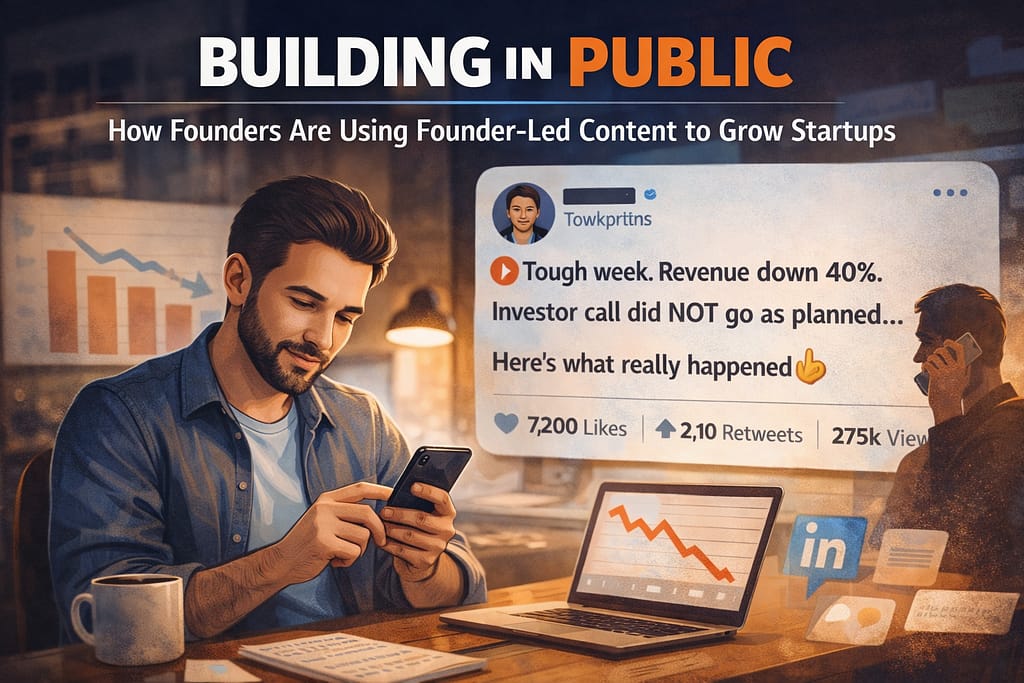
Whereas businesses previously spent months secretly working on a product before announcing it with a big launch, proponents of building in public now provide behind-the-scenes looks at product development, getting real-time user feedback in the process.
This means that you share your revenue numbers before they are impressive. You post about a feature that took three months and still doesn’t work properly. You write about the customer conversation that changed your entire product roadmap. You let people into the mess before it becomes the story.
Why does this work? Because 82% of consumers say they are more likely to trust a company when its leadership is active on social media, according to the Edelman Trust Barometer. Trust, in a world saturated with advertising, is the scarcest resource a startup can have.
Marie Martens, co-founder of Tally, built her company’s audience by sharing transparent revenue updates and milestones publicly, turning Tally’s blog into something closer to a personal diary. Beyond the product, readers followed a journey and invested emotionally in its outcome. As a matter of fact, that emotional investment is what no ad budget can buy.
The Numbers Behind the Trend
Adam Robinson from RB2B built his latest B2B startup to $4 million in ARR, attributing the growth mainly to founder-led marketing. He embraced the public approach by showing the good, the bad, and the ugly, and his followers grew fast alongside his ARR and signups.
In the same vein, Lovable hit $200 million ARR in under a year with just 100 employees. Their Head of Growth, Elena Verna, credits much of their success to founder-led content. CEO Anton Osika posts regularly; Verna herself has become one of the most followed voices in growth marketing, and their developer educator has built a dedicated following teaching people how to use the product. Each person reaches a different audience. Each post builds trust in a different corner of the internet.
It is also important to note that Gamma grew from $0 to $100 million ARR with fewer than 50 people through a similar approach. These are not outliers; rather, they are the new template worth pursuing.
And for founders who are still not convinced, Scale Venture Partners put it plainly after advising dozens of startups: investing in your founder brand is, without a doubt, the easiest and cheapest way to raise awareness of your company and build trust with prospective customers. On average, founders see 33% more leads when they post regularly on LinkedIn.
Where the Conversation Is Happening
All platforms are far from being equal; where you build in public matters as much as what you share.
X (Twitter): Where Tech Culture Lives
X maintains 103.9 million users in the United States as of 2025, with particularly strong engagement among tech professionals, investors, and industry influencers. The platform’s real-time nature makes it ideal for sharing quick insights, engaging in industry discussions, and building thought leadership.
For founders building in B2B, deep tech, or anything that needs investor attention, X remains indispensable. In February 2025, Sam Altman posted OpenAI’s developer roadmap for upcoming models on X, explaining plans to simplify the company’s product offerings. That post sparked widespread engagement with 7 million views and reinforced his technical leadership in public view.
LinkedIn: The B2B Growth Engine
If X is where tech culture happens, LinkedIn is where B2B deals happen. LinkedIn is the best place to start building a founder brand. It is easy to use, and for the vast majority of startups, it is where buyers already spend their time.
The strategy here is different from X. LinkedIn rewards depth over brevity. Posts that tell a full story, the one of a failure, a lesson, a counterintuitive insight, consistently outperform surface-level updates. The founders who win on LinkedIn are the ones willing to be genuinely useful, not just visible.
Carta’s CEO, Henry Ward, posts regularly about private markets and cap table management. However, more powerfully, Carta built an entire content operation around their data from 30,000 startups, turning raw numbers into narratives that go viral. When journalists need startup funding data, they call Carta. That is what founder-led content does at its ceiling. It makes you synonymous with your category.
Storytelling as the Underlying Engine
Across every platform, the mechanism is the same, and that is by storytelling. It is not always features, funding announcements, or press releases. It is a story.
Building in public is one of the most effective approaches for early-stage startups. There is something relatable about seeing the highs and lows of a founder’s journey where people feel like they are celebrating wins alongside the team and rooting for their success.
The basic human psychology is that we are wired for narrative. A product feature cannot create loyalty. A story about why a founder stayed up until 3 am fixing the feature because a customer in Kano was depending on it, which creates loyalty.
What This Means for African Founders
African startups have historically struggled with visibility, not because the quality of the work is lacking, but because the distribution mechanisms have been stacked against them. Western media covers Western founders. Western VCs amplify the voices they already know.
Founder-led content changes that equation because it is the great equalizer. A founder in Lagos with a genuine story and a consistent posting habit can build an audience that matches or exceeds a founder in San Francisco with a larger marketing budget.
Africa’s startup ecosystem raised $2.65 billion between January and October 2025, up 56% from the same period in 2024. Capital is coming. But the founders who will attract the most of it will not just be the ones with the best products. They will be the ones who have built audiences that trust them before the pitch deck is ever sent.
Consider what Bature Abdullahi of Schoola and Curri AI has demonstrated by sharing the Schoola story publicly across media and platforms. He built enough credibility to get into the Microsoft Startup for Founders programme and be recognised at the Africa IoT and AI Challenge. The content preceded the recognition. It always does.
The Practical Framework: How to Actually Do This
Knowing that founder-led content works is one thing. Knowing how to start without burning out is another. We have a rundown of how the framework is grounded in what works:
Start with one platform. Do not try to be everywhere. LinkedIn is the most effective platform for B2B founder-led content. Master it, and only expand to other platforms once you have seen success. For consumer startups, X or even TikTok may make more sense. But pick one and go deep before going wide.
Post consistency over perfection. For best results, startup founders should publish content consistently, aiming for two to three posts per week on platforms like LinkedIn, daily engagement on X, and bi-weekly long-form articles or podcasts. The founders who win at this game are not the ones who post the most beautifully written content. They are the ones who are still there six months later.
Tell the story only you can tell. Your failures are more valuable than your wins. Your specific market insight is more valuable than generic startup advice. The question to ask before every post is: what do I know about this that someone building a startup in Silicon Valley does not?
Document; do not just create. You do not need to manufacture content from nothing. Document what is actually happening, the customer call that changed your thinking, the feature you decided to cut, and the market insight from visiting a smallholder farm in Ogun State. The raw material is already in your workday. You just need to capture it.
Repurpose ruthlessly. Steli Efti’s team at Close turned any YouTube video into a blog post, podcast episode, and gated content, organically stumbling onto what is now called content repurposing, using one piece of content in many different formats to get more mileage from it. To break this down, it means one idea, five formats; and that is the formula.
The Honest Difficulty
None of this is as easy as it sounds on a listicle. Entrepreneurs may struggle with vulnerability and the pressure of constant public scrutiny. The expectation to consistently share valuable content can lead to burnout.
There is also the very real fear, particularly for African founders operating in competitive markets, that sharing openly gives competitors information. That fear is understandable. It is also mostly wrong, as execution is the moat, not secrecy. The founders who build in public are not giving away their advantage. They are building one that cannot be copied, which is systemic trust in the actual process. It is noteworthy that the goal is not perfection; rather, it is presence, showing up, being honest, and sharing the real thing.
The Bottom Line
The most successful startups of this decade are not only product companies; they are media companies that happen to sell a product. The founders building that way, on X, on LinkedIn, in newsletters, and in podcast studios, are building the most durable moat available to an early-stage company. And that is an audience that believes in them before they have a reason to.
In a funding environment where, as one African investor put it, capital now follows clarity, not hype, founder-led content is how you demonstrate that clarity in public, consistently, over time.
Start posting. Tell the real story. The audience is waiting.
TechPolyp spotlights Africa’s most promising startups, their journeys, challenges, and the people behind the products. Explore our startup directory and founder interviews to find the builders shaping the continent’s tech future.

