

In Nigeria, fewer than four in ten people use the internet, and nearly everyone has access to a phone. That gap, between connectivity and reachability, is the space Joshua Firima has chosen to build in, and the founding logic of KrosAI is almost embarrassingly simple once you see it. In essence, if AI cannot reach people through a browser, one can route it through a phone call instead.
As revealed in Techpolyp’s recent interview with Joshua Firima, the founder of KrosAI, the startup builds what Firima calls “distribution rails” for AI agents in emerging markets as the infrastructure that connects voice AI systems to local telco networks, allowing businesses and governments to deploy AI-powered services that any user can access by dialing a number.
Three Startups, One Throughline
Firima has been building since 2015. His first venture was a drag-and-drop website builder that reached 4,000 users and was acquired within ten months. However, that also marked his first exit. He then co-founded Moosbu, a B2B fintech and commerce platform that hit $240,000 in GMV within fifteen months before Nigeria’s 2023 cash crunch slowed digital payments enough to make competing with Moniepoint and Opay untenable.
The pivot to KrosAI was not impulsive, however. It came from watching ChatGPT emerge and noticing what it could not do as it relates to speaking Yoruba, understanding Hausa, and responding in Pidgin English without losing meaning. A freelance client in The Gambia dropped him mid-project because their conversations, mediated by Google Translate, never quite landed. That moment crystallized the problem.
“Most AI tools were designed for high-resource languages. If we have over 2,000 languages in Africa and less than 2% are represented in AI, a lot of those languages will go into extinction in the nearest future.” — Joshua Firima, Founder, KrosAI
The Rails, Not the Train
KrosAI’s flagship product, Oracle, launched in July 2025. It is a phone-based AI assistant that businesses can deploy via local telephone numbers, where customers can call in, and a voice AI agent responds in real time, in their language, with a latency of 20 milliseconds achieved through server co-location and audio chunking techniques.
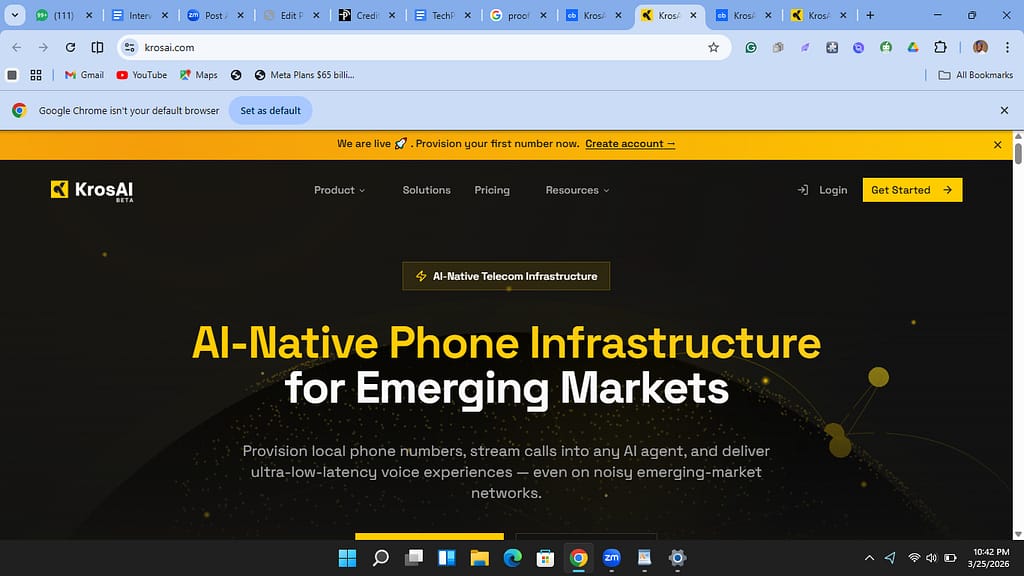
What makes KrosAI’s positioning distinctive is that it does not want to be the AI agent itself. It wants to be the infrastructure layer underneath any AI agent—platform-agnostic SDKs that can wrap around existing voice AI systems and deploy them across multiple markets simultaneously, each with a local phone number, each capable of multilingual real-time support regardless of call volume. Businesses bring their agent; KrosAI provides the rails. All conversations are encrypted end-to-end, with a default 30-day automatic data deletion policy built in.
Chasing the Next Billion, Not the Next Feature
KrosAI’s primary customers are enterprises and developers in fintech, telecoms, e-commerce, and healthcare sectors that handle high call volumes and serve customers across linguistic and geographic fault lines. However, the longer vision is more structural. Firima has described KrosAI’s ambition as becoming the default distribution layer for AI agents in emerging markets, becoming the AI similitude of what banking-as-a-service providers became for fintech.
The company supports languages including Yoruba, Hausa, Igbo, Swahili, Pidgin English, Malay, and Twi, with proprietary datasets fine-tuned for low-resource languages that global players like OpenAI and Google have not prioritized. That data moat, built over time, is the competitive differentiator that Firima believes will be hardest to replicate.
Early Numbers, Real Momentum
KrosAI has generated $36,000 in annual recurring revenue and counts several B2B clients with tens of thousands of end users. The company is backed by Right Side Capital, MARL Accelerator, Microsoft for Startups, Google for Startups, and the NVIDIA Inception Program. Its pivot from Moosbu produced 30+ businesses on a waitlist, 15 letters of intent, and a paying client within two months even before the product was fully built.
After rebuilding the system from scratch following a November relaunch, the team made a deliberate choice, which was to go deep on telephony infrastructure rather than broad on features. Customer demand eventually led them to add a basic AI agent builder tool, which they plan to announce soon. A pre-seed fundraising round is also in progress, with telco partnerships as the planned expansion vehicle.
What Comes After the Dial Tone
Firima believes that the next decade of African digital inclusion will not be won through apps and interfaces but through the channels people already trust. These are their voices, their languages, and their phones. If he is right, the infrastructure he is building today becomes the backbone of how hundreds of millions of people first encounter AI.
TechPolyp will be watching closely as KrosAI moves toward its pre-seed close and its first major telco partnership. The rails are being laid. The question now is how many trains choose to ride them.

